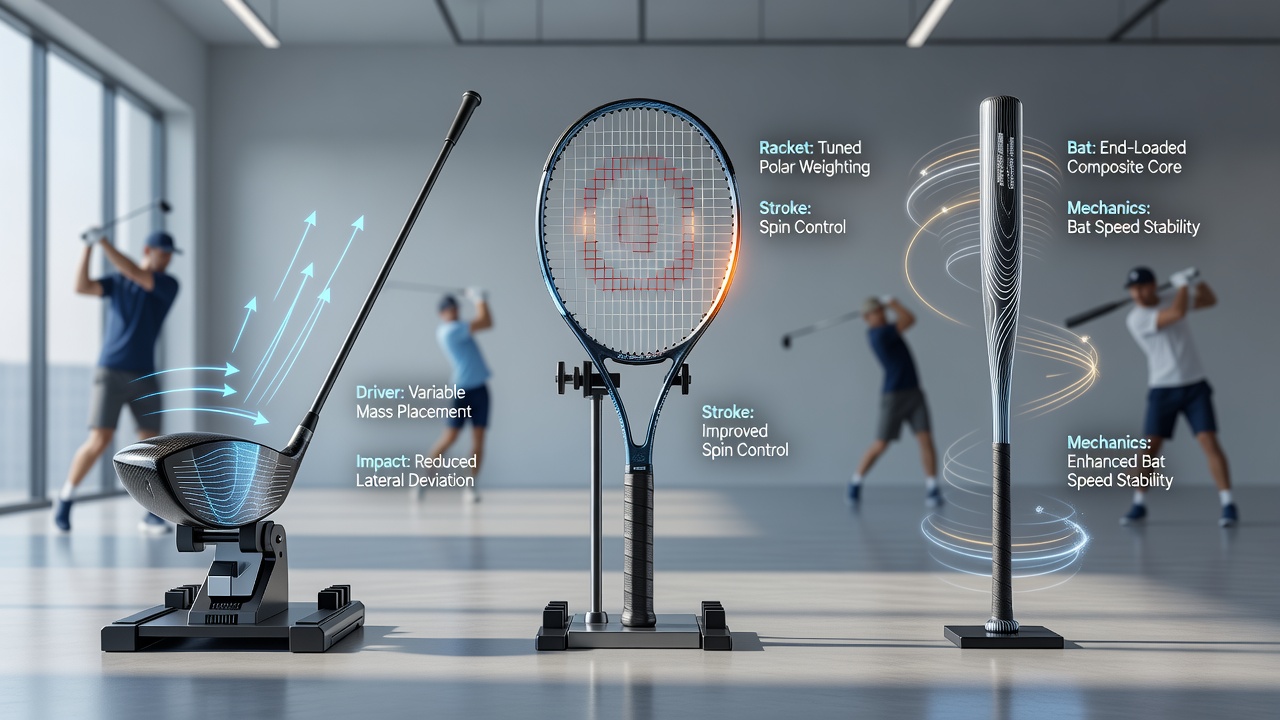
How Weight Distribution Patterns in Composite Materials Shape Swing Mechanics and Stroke Consistency in Golf Drivers, Tennis Rackets, and Baseball Bats
Composite materials in modern sports equipment let manufacturers position mass with precision that metal designs rarely achieve, and this control directly influences swing paths along with energy transfer at impact. Researchers tracking golfers, tennis players, and baseball athletes during multi-hour sessions note that shifts in center of gravity and moment of inertia alter both initial mechanics and performance as fatigue sets in. Studies published in sports engineering journals show that small changes in layup patterns produce measurable differences in club-head speed retention, racket face stability, and bat barrel control after repeated swings.
Core Principles of Mass Placement in Composites
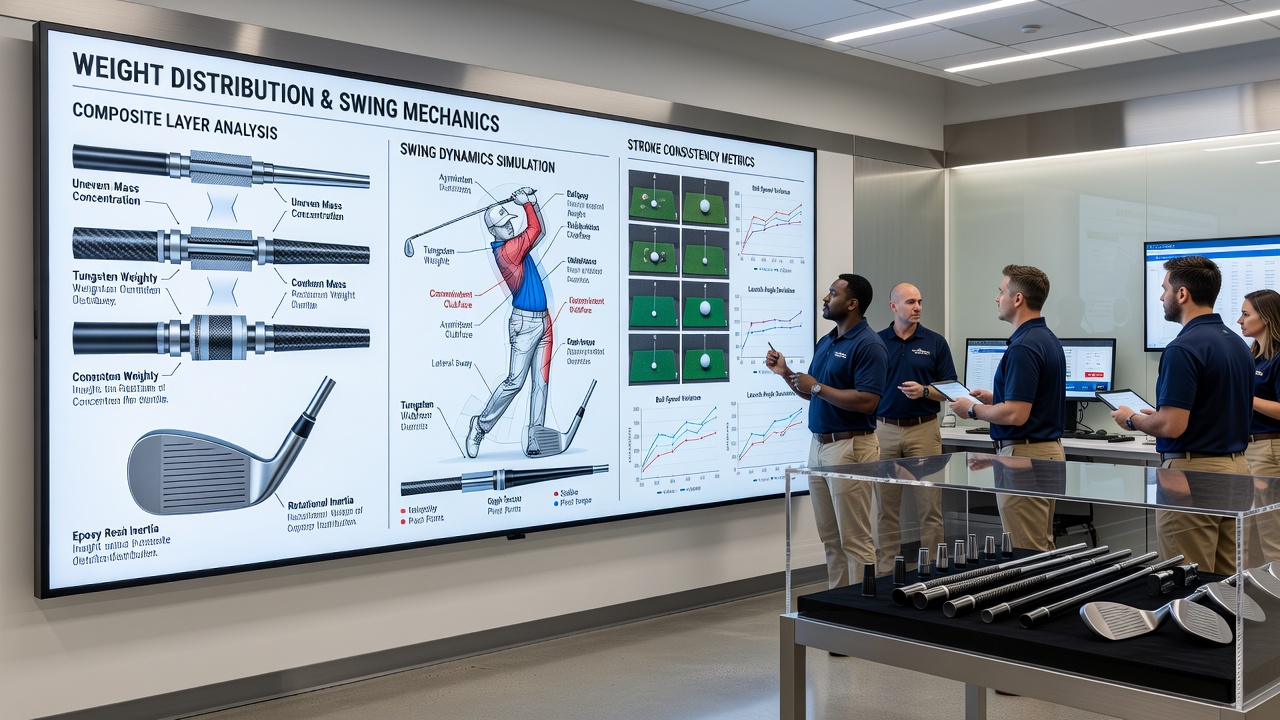
Engineers adjust fiber orientation and resin distribution to move weight toward the perimeter, the handle, or specific quadrants without adding bulk, while finite element analysis predicts how those choices affect torque resistance and vibration damping. Data collected at testing facilities in Australia and Canada indicate that a 5-millimeter shift in balance point can change swing radius enough to modify launch angles in drivers or topspin rates on groundstrokes. Observers note that athletes maintain tighter shot dispersion when the implement's moment of inertia matches their swing tempo, yet that match erodes once muscle endurance declines.
Golf Drivers: Launch Consistency Over Long Sessions
Manufacturers place heavier carbon plies near the crown and sole of drivers to raise the center of gravity slightly while expanding the perimeter weighting, and this configuration reduces twisting on off-center hits during early practice swings. Swing-robot trials conducted through 2025 and into August 2026 at facilities in the United States and United Kingdom demonstrate that drivers with lower moment of inertia lose roughly 1.2 meters per second of ball speed after 150 swings, whereas higher-inertia models retain speed better yet demand more effort from the golfer. Players who train beyond ninety minutes show progressive opening of the club face at impact when handle weighting remains too light, leading to wider dispersion patterns on the range.
Tennis Rackets: Stroke Stability Under Fatigue
Racket frames built with variable-density graphite layers allow weight to concentrate at 3 and 9 o'clock positions or toward the tip, and each choice changes how the string bed meets the ball after hundreds of strokes. Kinematic studies from European sports institutes reveal that rackets balanced 5 millimeters head-light preserve forearm pronation angles longer into a session compared with even-balance frames, although the head-light models transmit more vibration once grip pressure increases from tiredness. Tracking data from professional training camps show stroke-to-stroke variability in racket-head speed rising by 4 percent after two hours when mass sits too close to the handle, while tip-weighted frames maintain angular velocity yet increase elbow stress markers.
Baseball Bats: Barrel Control and Contact Consistency
Composite bats incorporate internal sleeves and end-loaded fiber sections that move the sweet spot while keeping overall mass within regulatory limits, and these adjustments affect how quickly the barrel returns to the hitting zone after each swing. Research conducted at Japanese and American laboratories finds that bats with 1.5 percent end-load retain higher exit velocities through 200 swings before velocity drops, whereas evenly distributed mass models show earlier decay in barrel speed yet smaller timing errors for contact-point accuracy. Batters who complete extended batting-practice blocks exhibit increased early-commitment swings when the center of percussion sits farther from the hands, because fatigue reduces the ability to adjust hand path mid-swing.
Interaction With Extended Training Fatigue
Across all three implements, weight-distribution patterns interact with neuromuscular fatigue so that initial mechanical advantages diminish once session length exceeds ninety minutes. Electromyography readings paired with motion-capture systems indicate that athletes recruit additional shoulder and wrist stabilizers when implement balance drifts from their accustomed pattern, and those extra activations correlate with rising variability in impact location. Equipment monitored during August 2026 pre-season camps showed that players using rackets, drivers, or bats matched to their fatigue profile maintained tighter standard deviations in launch parameters compared with those using standard stock models.
Measurement and Design Validation Methods
Manufacturers validate designs through robotic swing rigs and player-worn inertial sensors that record angular velocity, face angle, and impact location at rates exceeding 1000 hertz. Results from these protocols feed back into layup schedules so that subsequent production runs fine-tune mass placement for specific swing-speed cohorts. Organizations such as the International Society of Biomechanics in Sports compile datasets that link composite layup maps to on-field metrics, while the Canadian Centre for Ethics in Sport maintains standards that require documented performance consistency across repeated impacts.
Conclusion
Weight distribution engineered into composite golf drivers, tennis rackets, and baseball bats governs initial swing kinematics and determines how long those kinematics remain stable once training sessions extend. Data gathered across multiple continents show that targeted mass placement preserves launch consistency, stroke repeatability, and contact quality longer into fatigue states, and ongoing validation programs continue to refine those placements for different athlete profiles and session durations.