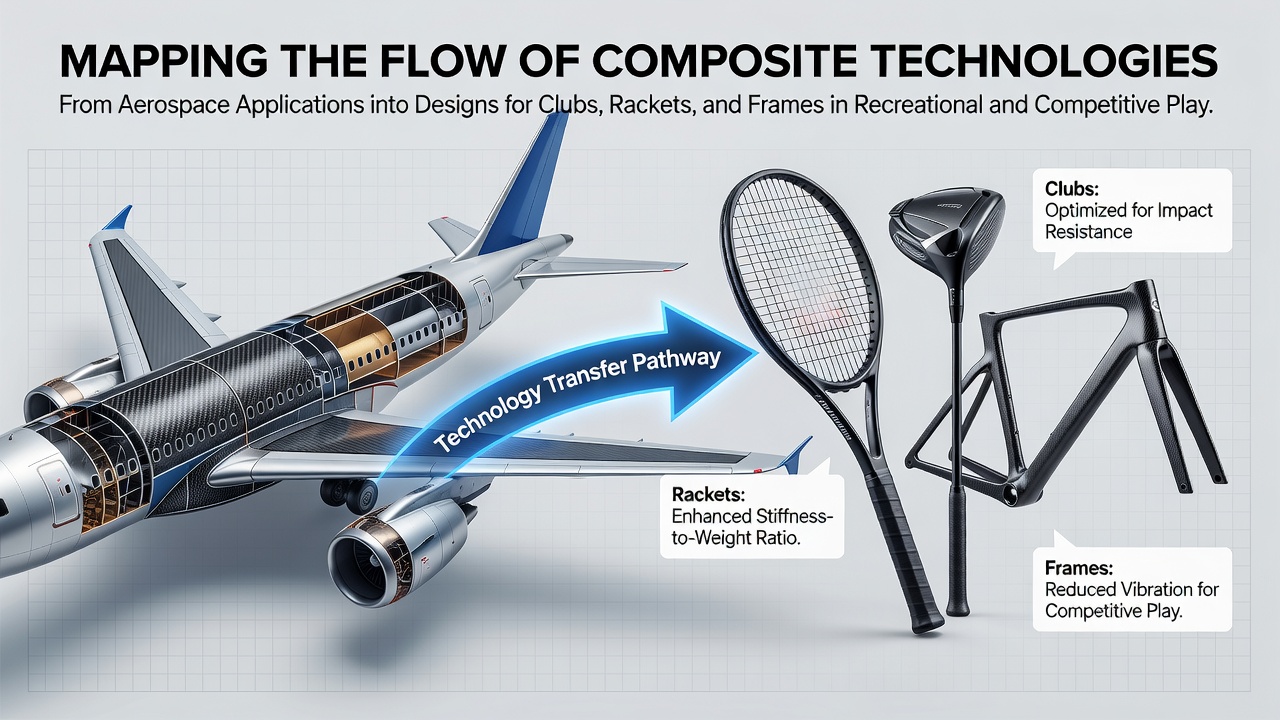
Mapping the Flow of Composite Technologies from Aerospace Applications into Designs for Clubs, Rackets, and Frames in Recreational and Competitive Play
Composite materials developed for aircraft and spacecraft have moved steadily into sports equipment since the mid-20th century, and researchers trace this path through documented patents and manufacturing records. Carbon fiber reinforced polymers first appeared in military aircraft structures during the 1960s, then entered tennis racket production by the late 1970s when manufacturers replaced wood and metal frames with lighter, stiffer alternatives that maintained structural integrity under repeated impacts.
Aerospace Origins of Key Materials
Engineers at NASA and European space agencies tested epoxy-matrix composites for their high strength-to-weight ratios in satellite components and fuselage panels, and those same properties proved useful once production costs dropped in the 1980s. Data from industry reports show that by 1990 commercial tennis racket frames incorporated up to 80 percent carbon fiber by volume, while golf club shafts adopted similar layups to reduce overall mass without sacrificing torsional resistance during swings.
Transfer to Racket Designs
Manufacturers adapted aerospace filament-winding techniques to create racket frames with variable stiffness zones, and studies published by university engineering departments in Canada documented how these layups reduced vibration transmission to the handle by measurable percentages. Players in competitive singles events noticed the change through consistent power delivery across different string tensions, while recreational users benefited from frames that withstood outdoor temperature swings without delamination.
Application in Club and Frame Structures
Golf club designers integrated pre-preg carbon sheets originally developed for wing spars, and production data from Japanese and American suppliers indicate that shaft flex profiles became tunable through specific fiber orientations rather than uniform metal tubing. Bicycle frame builders followed the same route in the 1990s, using autoclave curing methods borrowed from aircraft component lines to produce frames that passed repeated high-load fatigue tests required for racing certification.
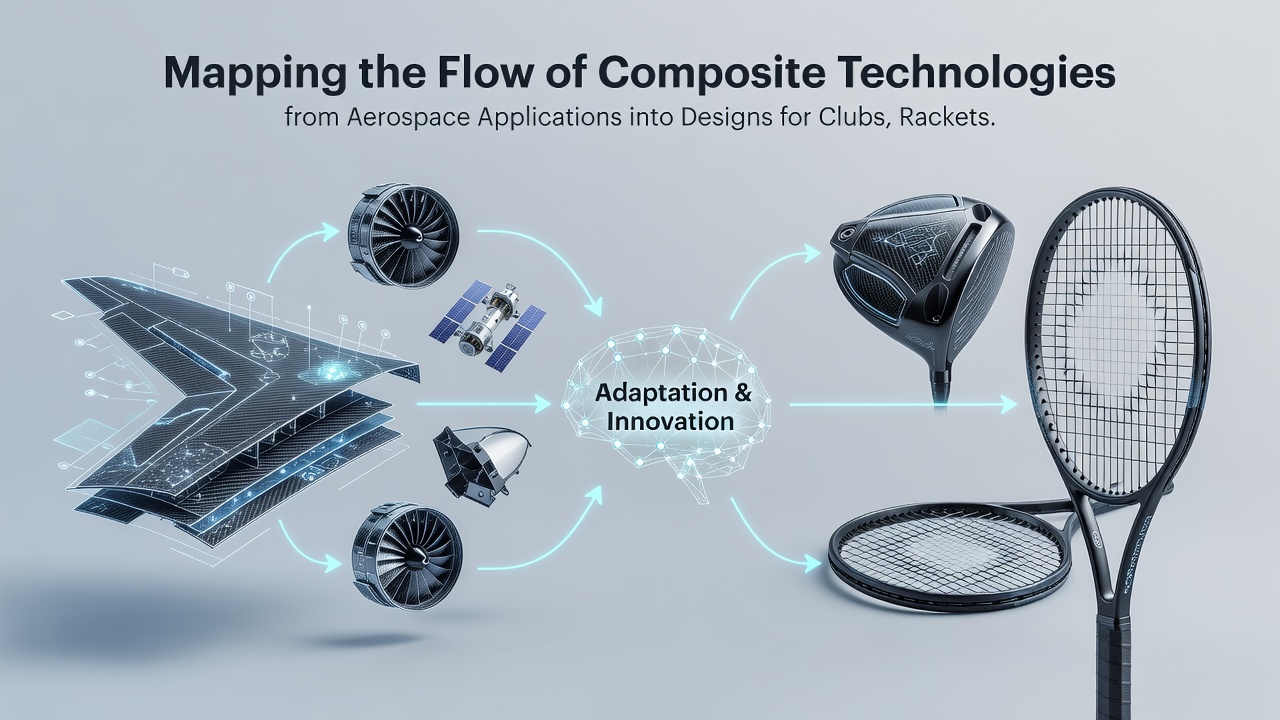
By the early 2000s, hybrid composites that combined carbon with aramid fibers appeared in both racket and club lines, and testing at independent laboratories confirmed improved impact resistance at the hoop and crown areas. Those modifications aligned with rule changes from international federations that limited maximum racket length and head size, prompting designers to optimize material distribution within the new dimensional constraints.
Recent Developments Through 2026
Supply chain records show continued refinement of out-of-autoclave curing processes that originated in defense aerospace programs, and several major equipment brands adopted these methods for high-volume racket and club production. In August 2026 industry conferences in Europe highlighted new resin systems that cure at lower temperatures while retaining the mechanical properties needed for competitive play, allowing smaller manufacturers in Asia and North America to enter the market with certified products.
Academic papers from Australian research institutions have tracked how nano-enhanced composites, first qualified for space vehicle thermal protection, now appear in select premium racket frames to improve fatigue life under repeated high-velocity impacts. Figures from these studies indicate measurable extensions in service intervals before stiffness loss becomes detectable through standardized testing protocols.
Cross-Industry Standards and Testing
Regulatory bodies in the United States and the European Union require sports equipment to meet impact and durability benchmarks that parallel aerospace material qualification procedures, and certification timelines reflect this overlap. Observers note that the same non-destructive inspection methods used on aircraft components, including ultrasonic scanning and thermography, now verify internal integrity in finished rackets and club shafts before they reach retail channels.
Those who've studied material migration patterns point to shared supplier networks between aerospace tier-one contractors and sports equipment producers as the primary channel for technology transfer. This connection has remained consistent even as raw material costs fluctuated, because the performance gains in swing speed and control justify the premium pricing tiers adopted across both recreational and professional segments.
Conclusion
The documented progression from aerospace composite applications to clubs, rackets, and frames rests on measurable engineering data rather than isolated innovations, and ongoing refinements continue to follow the same material science principles established decades earlier. Equipment meeting current certification standards reflects these cumulative advances in fiber architecture, resin chemistry, and manufacturing repeatability.