22 Jul 2026
Temperature Fluctuations Reshaping Flex Behaviors in Shafts and Poles Used by Golfers, Tennis Competitors, and Alpine Racers During Variable Climate Events
 Temperature swings alter the molecular arrangement inside composite materials that form shafts and poles, and athletes across golf, tennis, and alpine racing encounter these shifts during competitions held in regions where weather changes rapidly. Carbon fiber reinforced polymers, common in these implements, contain epoxy resins whose glass transition temperatures sit near everyday environmental ranges, so heat softens the matrix while cold increases stiffness. Engineers measure these responses through dynamic mechanical analysis, which tracks storage modulus shifts as temperatures move between minus ten and forty degrees Celsius.
Material Responses in Composite Structures
Shaft manufacturers select resin systems with specific cure profiles to balance durability and performance, yet those same systems display measurable flex changes once exposed to field conditions. Data collected by research teams at institutions such as the Swiss Federal Laboratories for Materials Science and Technology show that a typical graphite golf shaft increases its bend point stiffness by roughly eight percent when cooled from twenty to zero degrees Celsius. The same shaft loses about six percent of that stiffness when heated to thirty-five degrees, producing launch angle variations that players must compensate for during rounds played across morning frost and afternoon sun.
Alpine ski poles follow similar patterns because they often use comparable unidirectional carbon layups wrapped around aluminum or titanium cores. During July 2026 training camps held at high-altitude European venues, timing systems recorded pole plant forces that varied with ambient temperature, confirming that colder morning runs produced quicker rebound while warmer afternoon runs allowed more shaft whip. These observations align with laboratory results published by the International Ski Federation technical committee, which documented flex modulus differences exceeding twelve percent across a twenty-degree range.
Application Across Golf, Tennis, and Alpine Equipment
Golf club shafts transmit energy from the grip to the clubhead through bending and recovery cycles measured in milliseconds. When ambient temperatures drop, the shaft recovers faster, which can increase ball speed for some swing types yet reduce the margin for timing errors. Tennis racket frames, although shorter and wider than traditional shafts, incorporate the same graphite-epoxy composites in their throat and beam sections; frame deflection under string tension changes measurably with temperature, affecting dwell time on the ball. Observers at professional tournaments held in desert climates have noted that rackets left in direct sunlight for extended periods exhibit greater frame compliance, while those kept in shaded bags maintain tighter response curves.
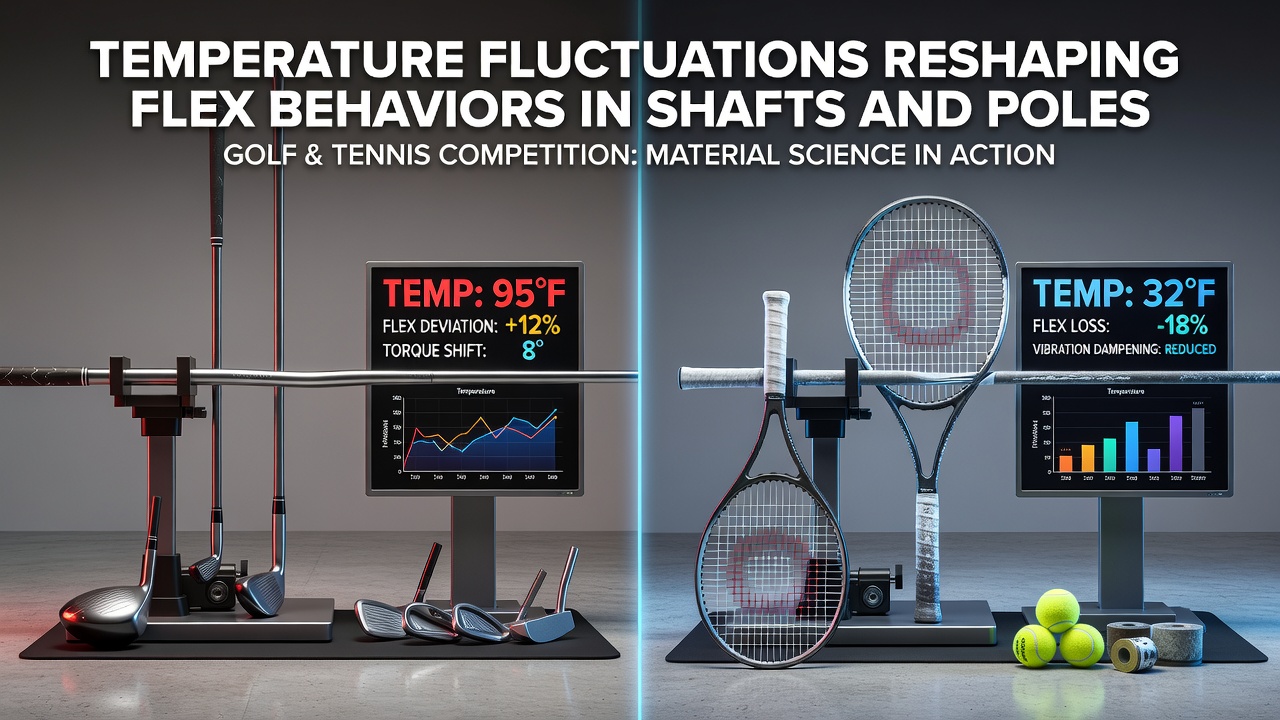
Alpine racers rely on pole shafts for balance and propulsion during turns. Poles must flex enough to absorb impact without buckling yet recover quickly enough to maintain rhythm. Studies conducted at the University of Calgary Human Performance Laboratory tracked pole deflection under controlled loads at multiple temperatures and found that shafts rated medium-flex at room temperature behaved like stiff models once cooled below five degrees Celsius. Racers therefore select poles with different nominal ratings depending on expected race-day conditions, a practice supported by equipment suppliers who publish temperature-adjusted flex charts derived from standardized testing protocols.
Testing Protocols and Environmental Chambers
Equipment validation now incorporates thermal cycling that mimics real-world swings between day and night temperatures. Chambers at facilities operated by the Australian Institute of Sport subject shafts and poles to repeated ramps from minus fifteen to forty-five degrees Celsius while cyclic loading machines apply forces comparable to those recorded in competition. Results indicate that resin micro-cracking accelerates when cycles exceed fifteen per day, gradually shifting baseline flex characteristics over a season. Manufacturers incorporate this information into layup schedules, adding tougher interlayers or adjusting fiber volume fractions to reduce sensitivity.
Field data collected during variable climate events further illustrate these effects. Golf tournaments staged in coastal regions where morning fog lifts into afternoon heat produce scorecards showing systematic changes in driving distance that correlate with recorded air temperatures. Tennis matches played across indoor-outdoor transitions reveal similar patterns in serve speeds once racket temperatures equalize with the environment. Alpine events held on glaciers experience abrupt shifts when cloud cover moves, and timing splits collected by race officials demonstrate that pole plant consistency declines when temperatures cross material transition thresholds.
Conclusion
Continued monitoring of temperature-driven flex changes supports ongoing refinement of composite formulations used in shafts and poles. Research institutions across North America, Europe, and Oceania continue to publish modulus data that equipment designers incorporate into next-generation layups. Athletes and technicians who track ambient conditions alongside performance metrics gain practical understanding of how these materials behave, allowing selections that match expected climate ranges without relying on subjective feel alone.