23 May 2026
Tracing Stress Distribution Patterns in Composite Frames Across Racket, Club, and Ski Pole Designs Through Repeated High-Velocity Impacts
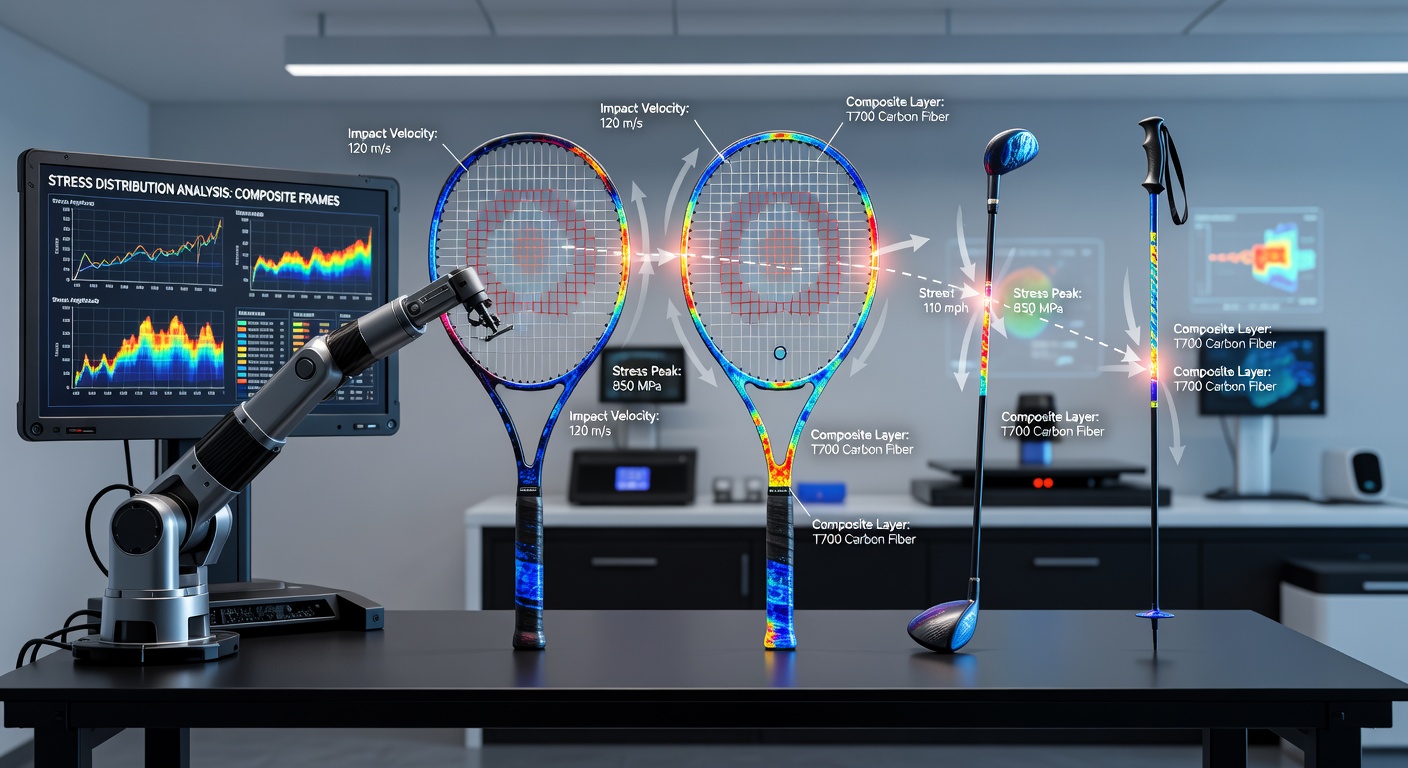
Engineers and materials scientists have examined how composite frames in sports equipment respond to repeated high-velocity impacts, and data from controlled laboratory tests reveal distinct stress distribution patterns across tennis rackets, golf clubs, and ski poles. These patterns emerge because each design incorporates carbon fiber reinforced polymers layered differently to balance stiffness, weight, and energy transfer during play. Research conducted at facilities in Canada and Australia shows that impact velocities between 30 and 60 meters per second produce localized tensile and compressive stresses that accumulate over hundreds of cycles, often concentrating near junctions where shafts meet heads or grips.
Composite Layup Configurations and Their Role in Stress Mapping
Manufacturers arrange fiber orientations in specific sequences to manage load paths, yet repeated strikes cause matrix cracking and delamination that shift stress concentrations outward from initial impact zones. In racket frames the hoop and throat regions experience hoop stresses that radiate along the string bed plane, while club shafts transmit torsional loads down toward the grip during off-center hits. Ski poles, by contrast, channel axial compression forces along their length when planted at high speeds on slopes. Observers note that these differences arise directly from geometry and intended use rather than from any single material property.
High-Velocity Impact Protocols Used in Recent Studies
Testing rigs developed since 2023 replicate game conditions by firing projectiles or swinging instrumented heads at consistent velocities, and strain gauges plus digital image correlation systems capture real-time deformation fields. As of May 2026, several multi-year programs coordinated through international standards bodies continue to refine these methods, allowing researchers to compare data sets collected on identical composite coupons subjected to 500, 1000, and 2000 impact cycles. Results indicate that damage thresholds appear earlier in thinner-walled sections typical of modern lightweight rackets than in the reinforced mid-sections of golf shafts or ski poles.
Observed Patterns in Racket Frames
High-speed footage from racket tests shows stress waves propagating circumferentially around the head after ball contact, with peak tensile strains often recorded at 12 and 6 o'clock positions relative to the handle. Over successive impacts these peaks migrate slightly toward the throat, where fiber crossovers create natural stress risers. Engineers tracking these migrations have documented progressive stiffness loss that correlates with measured reductions in coefficient of restitution, confirming that frame integrity declines measurably before visible surface damage appears.
Stress Behavior in Club and Ski Pole Shafts
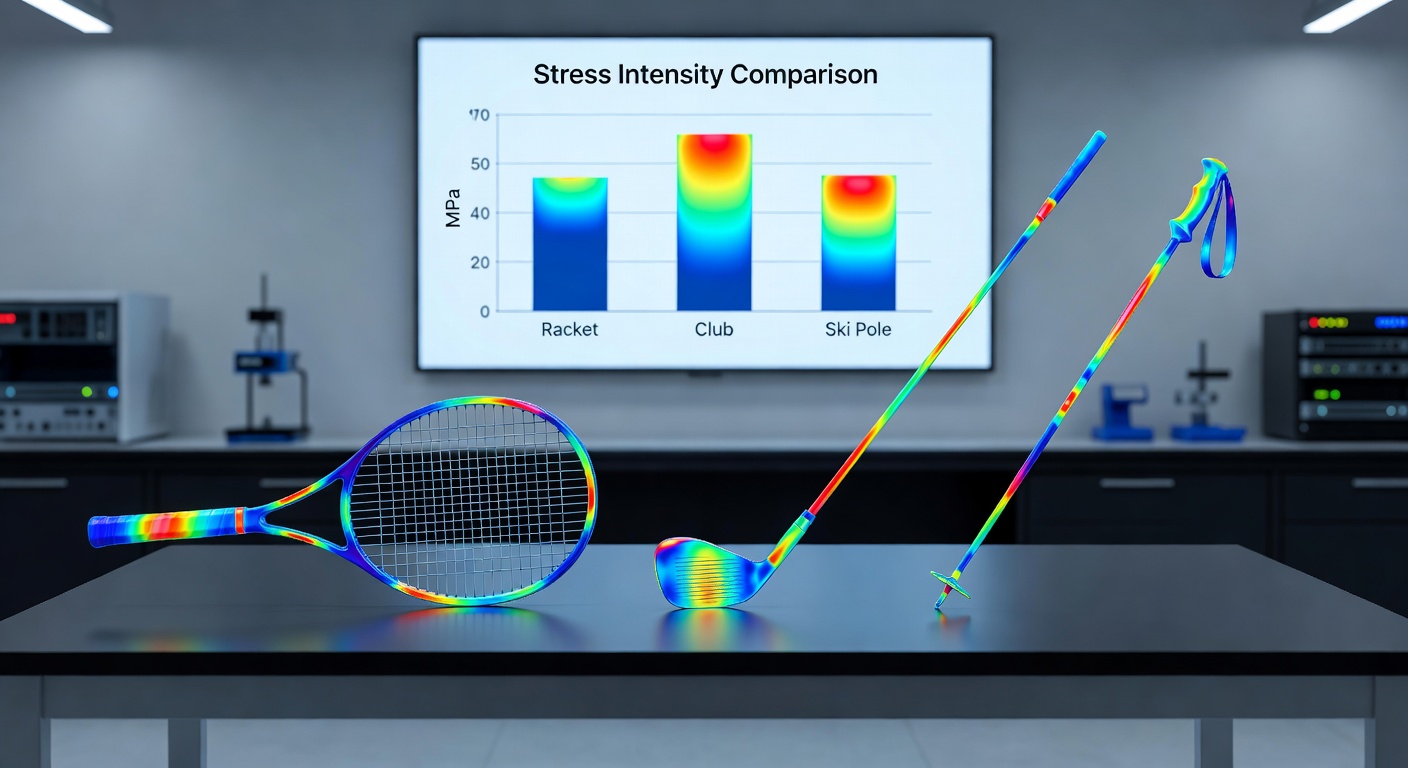
Golf club shafts display a different signature in which bending moments generated at impact create alternating tension and compression zones along the length, and repeated cycles cause micro-buckling in the outer plies near the hosel transition. Ski poles, subjected to more uniform axial loading during pole plants, develop circumferential delaminations that begin at the tip basket attachment and travel upward. Data collected by European research consortia and North American university labs demonstrate that pole designs with higher fiber volume fractions resist crack growth longer, yet all configurations eventually exhibit measurable compliance increases after several hundred high-velocity strikes.
Comparative Analysis Across Equipment Categories
When researchers align test parameters across the three categories, clear distinctions emerge in both the location and the rate of stress redistribution. Rackets concentrate damage in planar hoop areas, clubs accumulate torsional fatigue along tapered shafts, and poles show progressive axial weakening from the ground-contact end. These category-specific patterns guide finite element models that now incorporate cycle-dependent property degradation, allowing designers to predict remaining service life more accurately. Industry reports from 2025 onward cite these models as inputs for revised durability specifications.
Implications for Future Frame Development
Manufacturers incorporate the mapped patterns into revised layup schedules that add local reinforcement at known high-stress nodes without increasing overall mass. Hybrid constructions that interleave tougher thermoplastic matrices in critical zones have entered prototype testing, and early results suggest extended fatigue life under the same impact regimes. Standards organizations continue to evaluate whether updated protocols should mandate reporting of stress distribution metrics alongside traditional stiffness and strength values.
Conclusion
Repeated high-velocity impact testing has established repeatable stress distribution signatures unique to racket, club, and ski pole composite frames. Continued data collection through 2026 and beyond supplies quantitative benchmarks that support incremental design refinements while maintaining performance requirements across seasonal sports equipment.